Author Q&A in Clinical Education
Medical, Nursing, & Physical Therapy Programs
Courses that adopt Clear Cane Chronicles can include a live author Q&A on Zoom, connecting patient experience to:
- how context shapes real-world care delivery
- the impact of clinical and systems-level decisions
- patient safety risks that often go unnoticed
- gaps between provider expectations and patient behavior
And other aspects of person-centered care
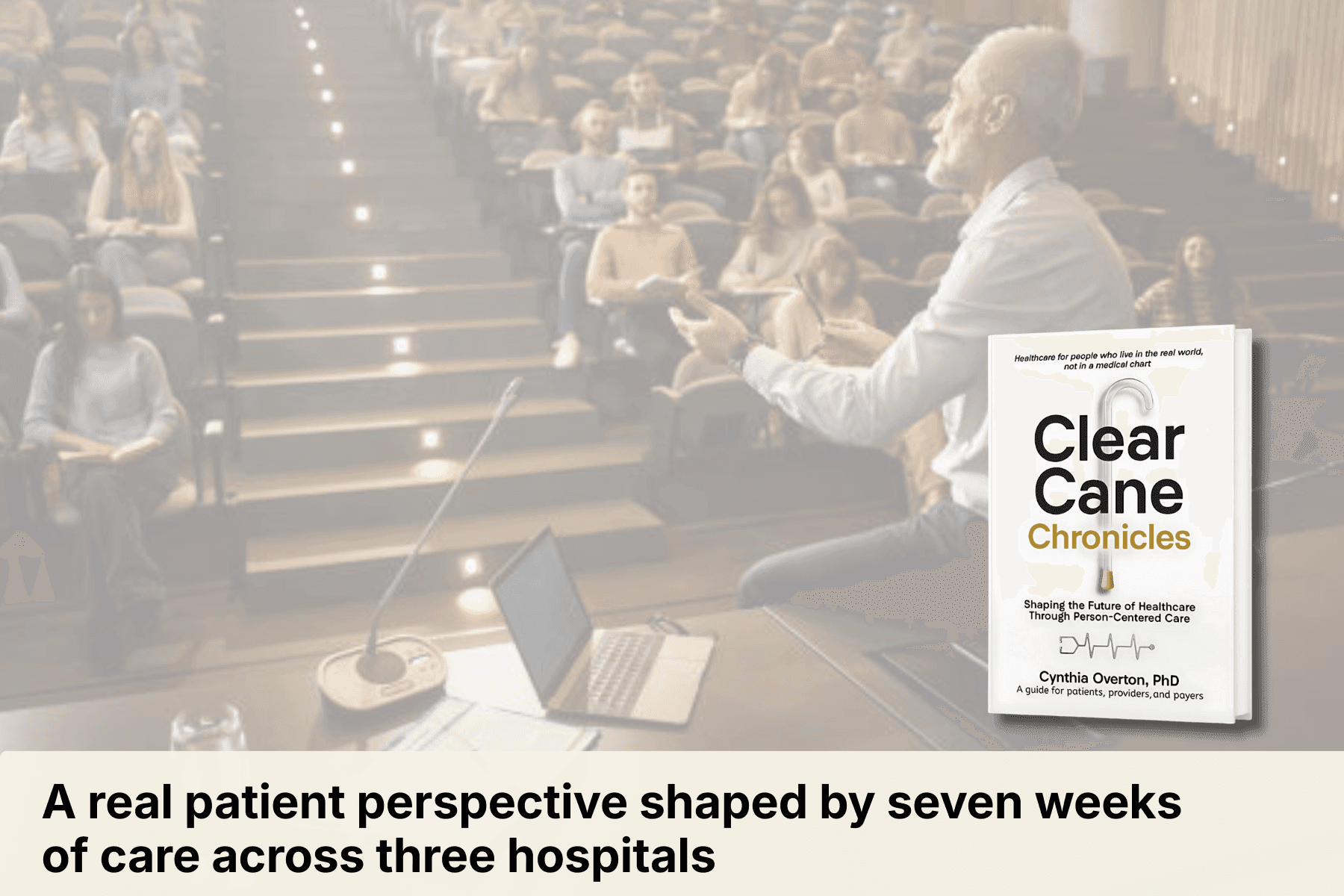
Clear Cane Chronicles: Shaping the Future of Healthcare Through Person-Centered Care is a patient-authored narrative used in health professions education to help students understand healthcare from the patient’s point of view, extending beyond diagnoses, protocols, and clinical workflows.
Educational Alignment
Clear Cane Chronicles can be used in medical, nursing, and rehabilitation education to support the following curriculum priorities:
Medical Education Programs
This offering supports LCME‑aligned domains such as:
- Professionalism
- Patient‑centered / person‑centered care
- Ethics
- Health systems science
It also reinforces AAMC Core Entrustable Professional Activities (EPAs), especially:
- Communication with patients and families (e.g., gathering the patient story, shared decision‑making)
- Interprofessional collaboration and team communication
- Care transitions and handovers across settings
- Systems awareness and response to system‑level barriers
The text complements pre‑clinical and clinical coursework by translating person‑centered care and health‑systems concepts from principle into lived experience, using narrative, research, and formal frameworks.
Nursing Education Programs
This offering aligns with contemporary professional nursing education priorities, including AACN Essentials domains such as person‑centered care, communication, quality and safety, and systems‑based practice. It can be used to deepen learning related to:
- Patient advocacy and communication
- Care coordination and continuity across settings
- Family engagement and caregiver roles
The book supports nursing students in understanding patient experience across acute, post‑acute, and community‑based care, with particular attention to system navigation, social drivers of health, and transitions.
Physical Therapy Education Programs
This offering is consistent with expectations reflected in CAPTE and APTA competency language around person‑centered care and functional outcomes. It can be used to illustrate:
- Patient‑centered goal setting and shared decision‑making
- Functional outcomes and quality of life from the patient’s perspective
- Longitudinal care relationships across settings
- Lived experience of disability, recovery, and long‑term adaptation
The text helps PT students connect clinical decision‑making, rehabilitation planning, and interprofessional coordination to real‑world patient priorities and long‑term functional impact.
Learning Objectives
After reading the book, engaging with its conversation starters, and reflecting on insights, learners will be able to:
1. Describe healthcare delivery from the patient’s perspective across inpatient, rehabilitation, and community settings.
2. Identify system‑level barriers (e.g., administrative burden, coverage decisions, fragmented transitions) that affect patient understanding, safety, and outcomes.
3. Reflect on the role of communication, empathy, and professionalism—across disciplines—in shaping clinical encounters and trust.
4. Recognize the impact of family caregivers, social support, and care transitions on patient experience and recovery.
5. Apply principles of person‑centered care and the Picker / NAB frameworks to future clinical encounters, including attention to social drivers of health and disability inclusion.
Optional Q&A with the Author
Programs that assign Clear Cane Chronicles may request a live 30-45-minute virtual Q&A session with the author.
The session allows students to:
- Engage directly with a patient perspective
- Ask questions about navigating healthcare systems
- Explore gaps between clinical intent and patient experience
- Participate in guided reflection and discussion
The Q&A is designed to integrate easily into existing courses, discussion sections, or reflection activities.

Explore a Program Fit
Contact us to learn more about using Clear Cane Chronicles in your curriculum.